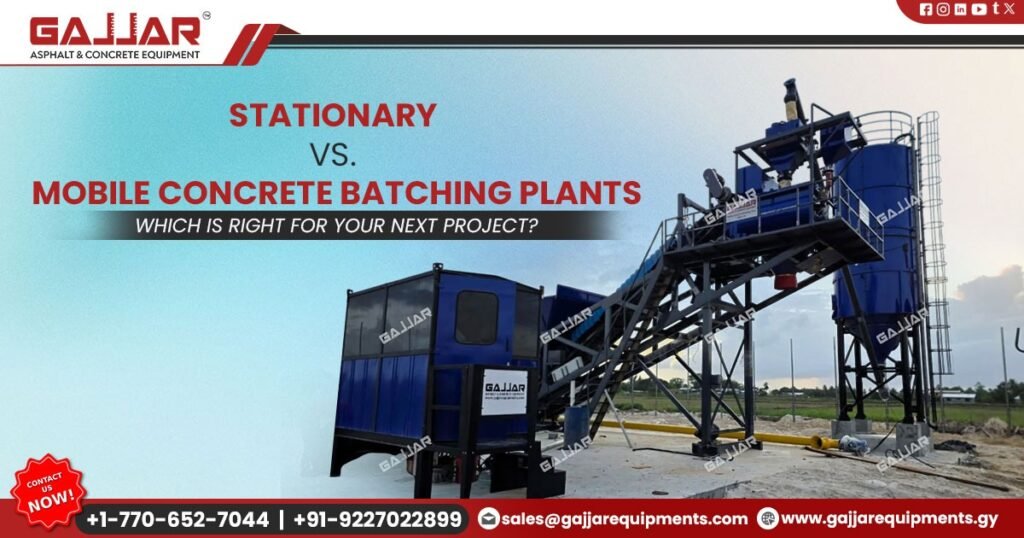
Choosing between a stationary and a mobile concrete batching plant is one of the most critical decisions in your project planning phase.
While both serve the same fundamental purpose—delivering high-quality, consistent concrete—they are engineered for very different operational goals.
As a leading manufacturer of construction equipment based in Ahmedabad, Gajjar Equipments has helped countless contractors and infrastructure firms
select the right plant for their specific site needs. Here is a breakdown of how to decide which configuration fits your business model.
1. Stationary Concrete Batching Plants: The Powerhouse
Best For:
Large-scale infrastructure projects (e.g., dams, airports, long-term highway contracts), commercial ready-mix supply businesses, and sites with high daily output requirements.
Key Advantages:
- Maximum Output: Engineered for continuous, heavy-duty production.
- Storage Capacity: Allows for larger aggregate and cement storage, reducing the frequency of replenishment.
- Cost Efficiency at Scale: Once installed, the cost per cubic meter of concrete is significantly lower due to high-speed, automated production.
Considerations:
Higher initial setup cost and a more complex foundation requirement. They are not intended for frequent relocation.
2. Mobile Concrete Batching Plants: The Flexible Solution
Best For:
Short to medium-term projects, remote infrastructure development, road construction moving along a linear path, and sites where space is at a premium.
Key Advantages:
- Rapid Deployment: Minimal site preparation (requiring only a flat, compacted surface) means faster mobilization.
- Proximity: You can position the plant closer to the pouring point, reducing transportation time for wet concrete and maintaining better mix quality.
- Resale Value: Highly modular, making them easy to sell or repurpose for different types of contracts.
Considerations:
Lower total daily storage capacity and generally lower maximum hourly output compared to large-scale stationary units.
3. Quick Comparison Table
Feature Comparison:
| Feature | Stationary Plant | Mobile Plant |
|---|---|---|
| Project Duration | Long term (Years) | Short/Medium term (Months) |
| Setup Time | Several Weeks | Few Days |
| Output Capacity | Very High | Moderate |
| Mobility | Fixed | Highly Portable |
| Site Prep | Extensive Foundation | Minimal |
4. How Gajjar Helps You Decide
At Gajjar Equipments, we recognize that your equipment must align with your project timeline and geography. Whether you are aiming to dominate a local market with a high-capacity stationary plant or need the agility of a mobile unit for a remote highway project, our engineering team ensures:
Standardized Quality:
Both our stationary and mobile models utilize high-precision load cells and PLC controls to ensure your mix adheres to strict construction standards.
Customization:
We tailor bin sizes, aggregate handling systems, and discharge heights based on your site’s unique constraints.
Reliability:
Both configurations are built to rigorous standards of wear resistance and operational uptime.
5. Final Thoughts
Still Undecided?
The best choice often depends on your specific logistics plan, aggregate source locations, and project duration.
Reach out to the engineering team at Gajjar Equipments for a site-specific consultation. A detailed cost-benefit analysis can help determine which
plant configuration will maximize your ROI.